
From 2022 to 2025 I ran SEO at XTB for the Czech, Slovak and Hungarian markets.
The content program combined more than 150 new articles, over 40 major updates, duplicate consolidation, internal linking and technical SEO.
This case study describes my own role and a publicly verifiable trend for the Czech site.
I don't claim one person or one change caused all the growth. Local colleagues, subject-matter reviewers, the legal team, developers and the strength of the XTB brand all contributed.
I use the same principle in my SEO consulting. I define the role of the URL, the search intent and the business priority first. Content or a dev ticket comes after that.
Where it started and what my role was
I joined XTB in June 2022 as SEO manager for CZ, SK and HU. The education section already existed. It needed a more systematic topic map, clearer ownership of queries and ongoing work on older content.
I was responsible for:
- topic, query and SERP research across three markets
- content priorities and the role of each URL
- writing and editing a large share of the Czech educational articles
- briefs for other authors and for expert review
- consolidating overlapping pages
- internal linking and technical SEO together with other teams
- measuring performance and deciding which pages to rewrite or leave alone
Financial content is YMYL (Your Money or Your Life), a topic that can seriously affect someone's finances, health or safety.
Search volume therefore never came before accuracy, risk warnings, current regulation and review by the expert or legal team.
What the public data shows
The charts below come from Ahrefs and show estimates for the Czech part of the site, xtb.com/cz. June 2022 marks when I started. I left in April 2025.
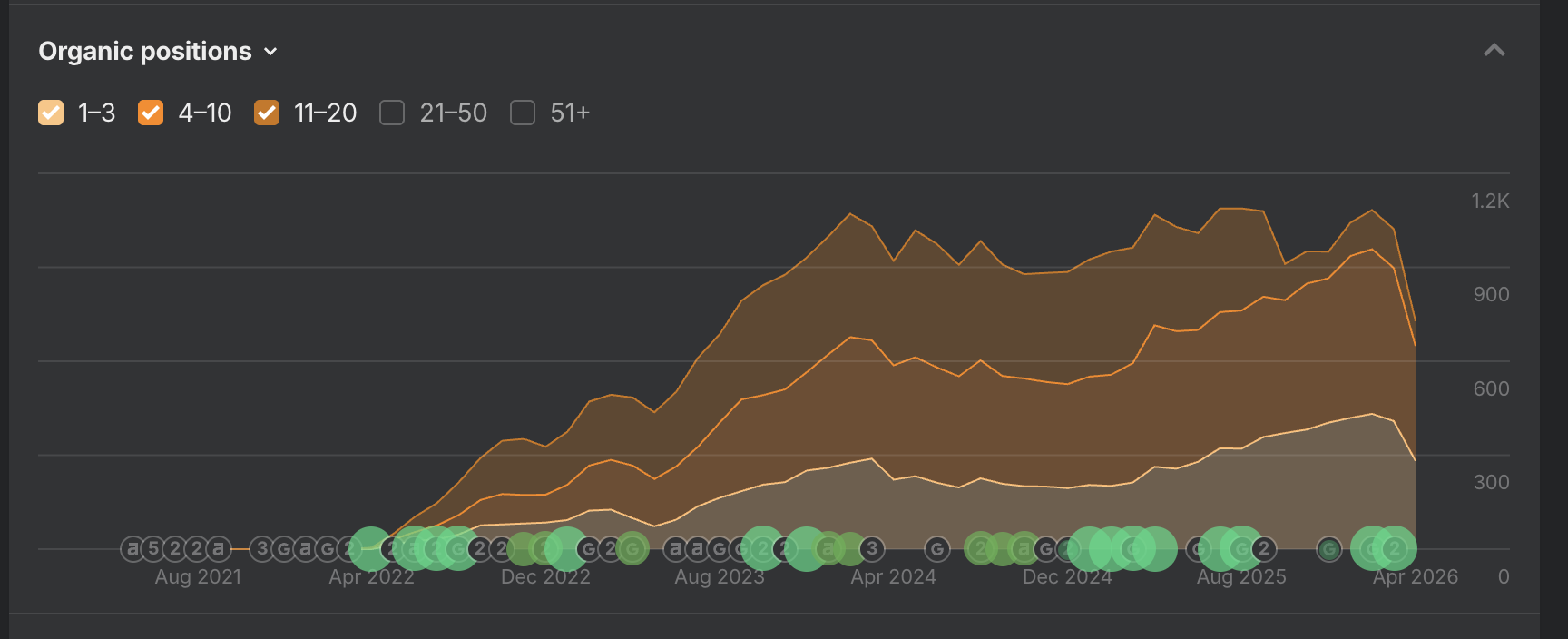
From June 2022, the number of keywords in the top 20 grew steadily across the 1–3, 4–10 and 11–20 groups.
By the end of 2023, visibility on the chart had roughly tripled. Later it held at around 1,000 to 1,200 positions.
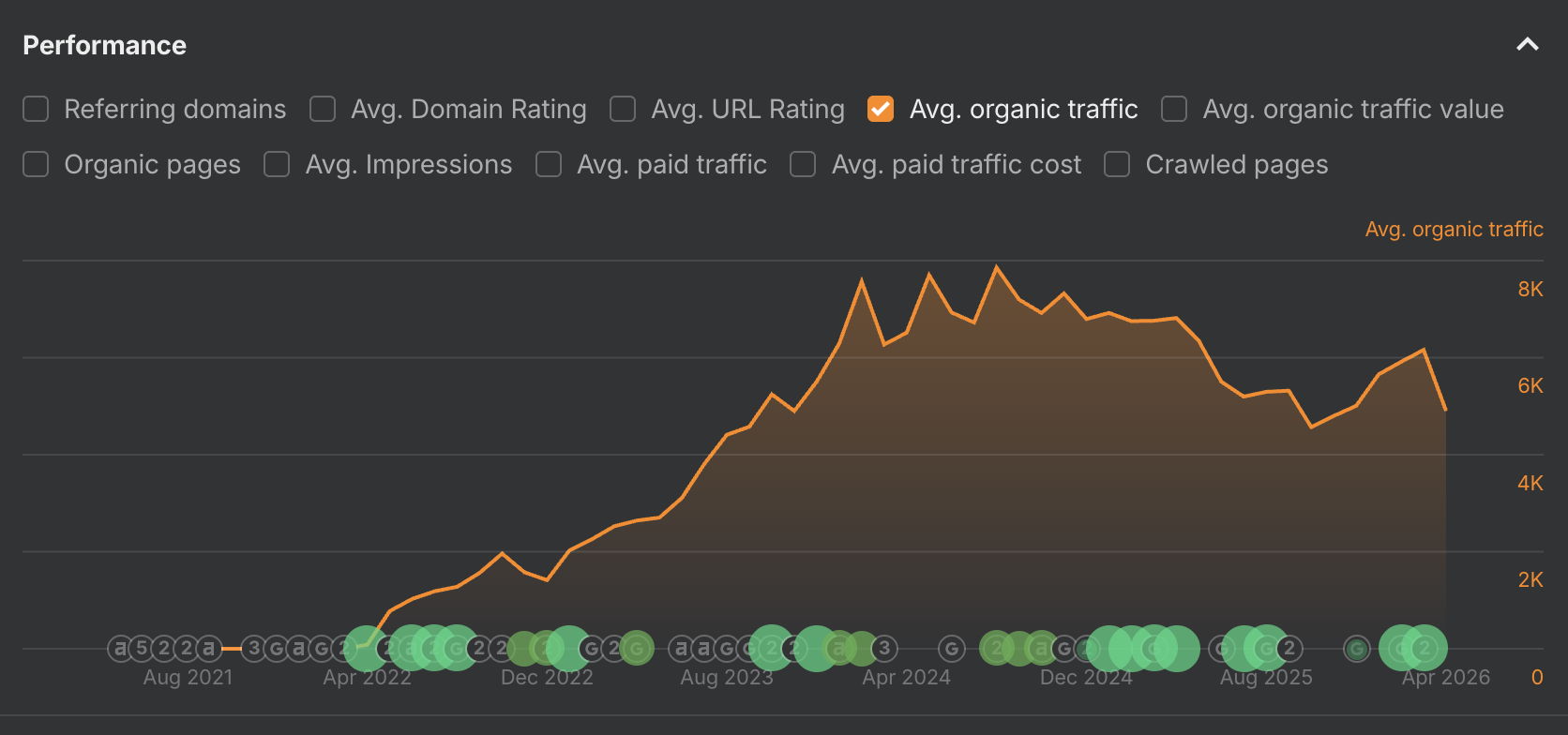
Estimated organic traffic in Ahrefs climbs from a low base in June 2022 to a peak of around 8,000 visits a month in 2024. The chart is the tool's public estimate. It is not XTB's internal traffic.
Both charts have two limits. Ahrefs models traffic from rankings and search volume, so this isn't XTB's analytics.
And timing alone doesn't prove how much of the change came from a specific activity, the brand, the market or a Google update.
How I built the content opportunity map
The research didn't start with an export of the highest-volume phrases. For each topic I combined search volume, intent, what the SERP looked like, the existing URLs, business value and whether XTB could give a trustworthy answer.
Each working decision had four possible outcomes:
- create a new URL for a missing, distinct intent
- rewrite an existing article that had history but didn't match what users needed
- merge overlapping pages and keep the stronger target
- deliberately not publish, if the topic brought no relevant traffic or we lacked the expertise
Proper keyword research has to end in a map of URLs and priorities, with the volume table as an input. That map is what let me coordinate authors, reviews and technical changes across several markets.
150+ new articles was never the success metric
Over three years we published more than 150 new articles and over 40 major rewrites. The publishing count describes the work. It says nothing about the result.
For each page, these mattered more:
- which intent and topic cluster it covers
- whether it gives an original, expert-correct explanation
- which follow-up questions and products it links to
- whether it can be crawled, indexed and measured
- how its performance changes after publishing or a rewrite
A rewrite could be worth more than a new article. An older URL already had history and links, but often needed a more precise answer, a better structure, fresh data or less overlap with another page.
Example: CFDs, from definition to decision path
The article What is CFD trading (in Czech) shows how one page can serve several related informational needs without spinning off duplicate URLs.
The structure takes the reader from the definition through how it works and a practical example to leverage, risk, regulation and choosing a platform.
The order follows the decision path. A beginner first needs to understand the instrument, and only then its variants and context.
I didn't stuff keywords into H2s. Each section answered a different question and still belonged to one coherent topic.
Three query types, three SEO strategies
The same format didn't work for every topic. The decision depended on the competition and how broad the intent was.
Forex: a realistic goal in heavy competition
On a broad topic like forex, brokers compete with big media and specialist portals.
I never set "position one at any cost" as the goal. The aim was an expert-correct entry into a competitive topic and coverage of the variants beginners actually search for.
Spread: a narrow definitional intent
Spread has a narrower intent. One precise definition with a practical explanation could serve several variants, like "bid ask spread" or "spread forex" and their Czech equivalents, without splitting them into several weak articles.
S&P 500: specific queries over the broadest phrase
On S&P 500, beating every financial portal on the most generic query wasn't realistic.
So the content targeted more specific decisions: how to invest, which ETFs exist, the historical context and what a Czech investor needs to know.
That spread performance across dozens of relevant variants. It is more stable than depending on one generic phrase with a different intent.
What mattered besides content
The content program wouldn't have worked without the technical and organizational basics. Every new page needed the right template, indexability, an internal path, measurement and an owner for updates.
So we also kept working on:
- internal links between educational articles and relevant parts of the site
- duplicate consolidation and redirects
- metadata and template elements
- technical errors affecting crawling or indexing
- publishing QA and a performance review afterwards
- working with the legal and product teams
SEO was never a one-off project. It ran as a repeating cycle: research, decision, implementation, review, next priority. An SEO retainer with me works on the same loop.
What I would do differently today
Looking back, I would have introduced a stricter map of URL roles earlier.
For every important topic cluster, one place would show which URL owns the main intent, which pages support it and under what conditions new content gets created.
I would also log the date of every significant content and technical change more systematically. On a chart you can then tell publishing, rewrites, internal linking, template changes and outside factors apart.
Today I also work with query fan-out in research. I break a complex question into related sub-questions, but I don't automatically create a new URL for each one.
First I check whether it needs its own result or belongs inside a stronger page.
What carries over to your site
The growth of XTB's Czech education section didn't come from one article or a secret tool. It came from steady research, writing and rewrites, expert review, internal links, consolidation and technical implementation.
The rules that transfer best:
- Every URL needs a clear role and an owner of its intent.
- Publishing volume means nothing without visibility, traffic and a link to the business.
- Good content needs an update process, a technical foundation and a check after it goes live.
If you need to set content and technical priorities for your site the same way, see how I work as an SEO consultant. For a larger content map, keyword research is the separate next step.